
Index |
Next |
Prev |
Myfanwy
An Echo Chamber
I Built A New PC
Myfanwy
5:00pm, Tuesday, March 24, 2026
Current mood: relaxed 
If you're a fan of Welsh male voice choirs you will certainly be familiar with "Myfanwy", one of the best in a great field of Welsh choral songs. I had certainly heard it a number of times over the years but I heard it again recently on YouTube sung unaccompanied by Olwen Morgan in memoriam to the Aberfan disaster. Her heartfelt rendition inspired me transcribe it and create my own arrangement of this all-time classic.

The song was written in 1875 with words by Richard Davies, ("Mynyddog") and music by Joseph Parry. It
is most often heard in Parry's TTBB male voice choir arrangement and it is a truly wonderful piece of work all round. I don't speak Welsh but I love the sound of it and it is clear that this is high grade poetry, being the sad heartfelt plea from a man to his failed love. The choral version is set in Db to suit proper tenors as it goes up to a high Ab. The range is just an octave so it may be sung in the original key an octave low by a bass but although it is easily possible it is a little low for proper dramatic effect. The famous Welsh baritone: Bryn Terfel sang it in G, which is a good key for most people as it only goes up to a D. I chose this key before independently as it was the first key I tried after transposing the song and it worked well.

It took me the best part of a day to transcribe the choral version from a crappy JPG, type in the lyrics, analyse the harmony, transpose it and write the piano accompaniment. I have done a lot of harmonic analysis over the decades and I know when I am working on a masterpiece. Joseph Parry really knew his stuff and he certainly made the most of a relatively simple tune. His use of long drones by the low voices might seem overly simple at first glance but in fact, it is the best way to accompany this tune. One of the signs of a master is not to overdo an arrangement. Just because you CAN doesn't always mean that you SHOULD! Sometimes you need to step back and give the melody the floor. This is one such time.

Parry also shows his class with his TASTEFUL use of suspensions, 9ths, 4ths, diminished and augmented chords. Just one of each over the whole verse; beautifully restrained and the effect is magnificent. It was a pleasure to work with his harmonies and I only found cause to change it twice and then only for one note each. I was able to add more notes below the melody and lower bass notes as I was writing for the piano. I could have gone over the top but, like Parry, I kept it simple, honoured the harmonies and let the song speak. In the end I was taking notes out in order to keep the proper effect.


My arrangement (click for full score).
I am not Welsh but my great, great, grandfather was and I have been to Wales a few times and have always enjoyed myself there and found occasion to sing in Welsh. I pretty much know Hen Wlad Fy Nhadau and Calon Lân off by heart and I found that when I launched into these at pubs the locals would join in. Good times!

If you have access to a piano I recommend you give my piano arrangement a go and if you have someone who can sing in Welsh so much the better. I found it fun to play and so should you.
Just another day in the life of a composer. My life is full of days like these.
 The wonderful thing about music is that there is always more! It never runs out for me. Sure, the inspiration to write songs is not as hot as it once was but I'm still writing SOME tunes and in the meantime there is an entire WORLD of songs to harmonise and arrange. Bozhe moi!

Currently reading:
Overgeared by Park Saenal/Redice Studio.
An Echo Chamber
8:00pm, Monday, April 27th, 2026
Current mood: tired 
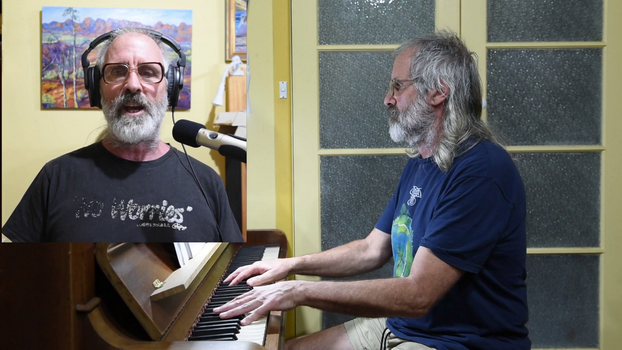
YouTube thumbnail of "An Echo Chamber". Click to watch the clip.
At 3am on 26th of Feb I was awoken with the first line of a song. The line was "You live your life in an echo chamber." It came with part of a tune, so I went to the piano and hit E4 and found the first part of the melody in C. It sounded too plain so I tried it in D and found the first suspension, then moved it to E, which seemed best, where I found the bass line. From there it was straightforward to find the rest of the tune although I had to write a high E in order to make the 2nd half work.
This was the first time, (but not the last), that I needed to do a proper arrangement, while I was writing the tune, in order to FIND the tune. I suspect that a lot of musically advanced songs are written this way. The bass line can dictate some parts of the tune as well as the harmony which produces unexpected results and can help an old songwriter like myself to find new jewels in a thoroughly worked-over landscape.
We tune-smiths all eventually find ourselves in rut and it's not so easy to break out. Guitarist songwriters are usually the first to fall into the mire as the melodic landscape visible from the guitar appears much more limited than it does on the piano. Having said that, it is possible to play anything on the guitar, so in THEORY it is possible to write anything but in FACT the more advanced tunes and harmonies are much harder to find there.
The landscape visible on the piano appears much broader and richer and the creative tune-smith can have a long and productive time there exploring multitudes of ideas. Writing in different keys is a wonderful way to break through the block of rehashing your previous finds but eventually even that palls.

A SONG is a special kind of melody that has to grab the heart and it has to be strong and unique. Most people are incapable of finding such a thing and most of those that do find some good tunes only manage a handful of really good ones and spend their productive life churning out weak things and rehashes of their good stuff. Bruce Springsteen is a classic example and most famous pop stars are in the same boat. Most of these people have less than 100 finished songs, often less than 50.
There are not many song writers who can keep the good stuff coming for decades and who have written 20 or more great songs: Paul McCartney, Paul Simon, Billy Joel, Carole King, Bob Dylan, Chuck Berry, John Lennon, Burt Bacharach, Richard Rodgers, Irving Berlin, Elton John, Neil Diamond, John Fogerty, Ian Anderson, Tom Waits... There aren't too many more. You can look at Rolling Stone's "100 Greatest Songwriters" list and most of them are mediocre or only produced 10 or less great songs. Jimmy Webb and James Taylor are good examples of the latter: Whilst they do have GREAT songs there are only 10 or so of them each. Lennon & McCartney are on an entirely different level. Singers like Bjork, Prince and Tom Petty simply don't have ANY great songs and most of Rolling Stones' candidates are in the same boat. Clearly Rolling Stone have their head up their arse and have no idea of what constitutes a great song. A rap is not a song and Richard Rodgers, who wrote "The Sound Of Music", "Oklahoma" and "South Pacific", didn't even make the list!

Anyway, I have written almost 300 songs now and I think they are all strong and all unique. You can decide for yourself whether I am deluded after you have heard them professionally performed and recorded. In any event I have certainly churned out a lot of songs over a long period of 50 years with no sign of stopping. Few indeed can say that. Even greats like Billy Joel, Paul McCartney, Carole King and Bob Dylan wrote their last good song before they were 60, probably before they were 50.

We have all faced the problem of our well of inspiration running dry. Even those of us blest with the deepest wells eventually find the bottom. For many years I assumed that I would never reach the bottom as I could always find a good new tune, alas though, for the past few years it hasn't been as easy as it used to be. This doesn't mean that my well is completely dry though. Clearly not! However I have found that I need to change my attitude, perspective or approach in order to find clean, new water.

I was happy with my tune to "An Echo Chamber" and set about writing more words. Since the first line was already there it was just a matter of expanding the subject to 4 verses. It is a piece of cautionary advice to the Millennial "cancel culture" who are intolerant beyond the dreams of the older generations and who think that they can simply shut out the dissenting voices in the outside world and everything will be fine. Clearly it won't! Hiding one's head in the sand is a recipe for disaster.

I refined my piano accompaniment over the following week and then set about trying to sing it. The song is simple enough to sing until you get to the high note. I am a standard bass with a range from E4 to E2, although I can sometimes hit notes outside this depending on the day. The high note is an E4 and I used to be able to sing it without trouble but at 64 I found it VERY difficult and began to wonder if it were possible for me at all. When I was a teenager I wrote plenty of E4s in my songs and it was just another note in my range. Not so much now...

I had some persistent throat phlegm and I busied myself with other musical projects while I waited for it to subside. After a week in Edenhope where I sang every day I felt like I might be able to get there and then I was able to reclaim most of what I had lost by concentrating on strong diaphragm pressure rather than throat pressure and a lot of chest voice to compete with the volume of my piano with the lid up.
This made the difference and after hitting some high Es I set about recording the piano part and then the vocal part.
The piano part was VERY difficult for me, just as it had been for "Carry Me Back To East Kentucky". I am not a concert pianist and although I can play each section of my arrangements I find that when I try to put them together at proper tempo with the recording pressure I inevitably make mistakes. It took me around 50 takes to get enough usable takes to make the backing track. Considering it isn't THAT hard a piece I find it hard to explain why...

The vocal part was easy EXCEPT for the high note! I knew I wasn't going to get a beautiful clean note so I was shooting for something that was more or less in tune. I was able to hit it in practice but once the phones were on my ears I couldn't sing quite the same way and murdered a bunch of attempts. Ah well. I was able to get some takes that I was prepared to put up with even though I knew they weren't ideal. Close enough would have to do. I had a song to get out after all! I eschewed the idea of running my vocal takes through pitch correction. I prefer to let my voice speak for itself. It may not be perfect but at least it isn't fake and I can sing all my stuff live without a mic and achieve the same result.
Mixing the various audio takes together was tricky and time consuming as I had to sync them all manually as I did not use a click track. Eventually I got it sorted however and then it was time to mix together the video tracks...
Each audio take had its corresponding video take but they were not synced together in any way and that had to be done manually as well. I had hoped to use the low grade audio track from the camera to help with this but there was little visual similarity between the proper audio track waveform and the one from the camera mic. It was a tiresome process but eventually I had it. Then I needed to crop the vocal video into a box in the corner of the piano footage. Shotcut changed the screen to something horrible that I couldn't return from and then hung up before I had saved it all. Not happy!

This was not my first rodeo however and I simply put my head down and retraced my steps. In the end I probably lost only 30 minutes and I soon had the video done and exported.
After leaving the final result until the next day I adjusted the audio mix a little before generating the final cut and uploading it to YouTube. I was happy with the end result despite its imperfections as I am realist and I know that perfection is not going to be possible in my current situation. Clearly a better result could be achieved with in a professional studio with professional musicians but this is what we have for now. In judging the innate quality of the song you should take this into account before making a fatuous statement like "It doesn't sound as good as "The Beatles". Of course it doesn't! They had an expert team working with them and they were young, energetic, in fine voice and NOT suffering from arthritis...

In order to judge the song and not the recording you should ask yourself: "What would it have sounded like if the Beatles had recorded it? Here's the YouTube clip. Have a good listen and ask yourself the question...
Here is the music score if anyone wants to have a go at it.
Currently reading:
The Left Hand of Darkness by Ursula Le Guin
I Built A New PC
3:00pm, Thursday, October 15, 2026
Current mood: calm 
The Routine
I've been building my own PCs since the 1990s. I've lost count of the number. Every time it's the same:
- You research the new technology:

- What are the latest CPU sockets?
- What are the latest processors?
- What support chipsets & motherboards support those CPU sockets?
- What are the latest RAM modules?
- What are the latest SSD standards?
- What are the latest HDD standards?
- What are the latest onboard and 3rd party graphics?
- What are the latest USB standards?
- Then you decide which CPU is for you: How much speed do you need? How much money do I want to spend? How much power will it consume?
- Then you decide how much RAM, SSD and HDD you need.
- Then you decide what graphics you want: On board or a 3rd party graphics card.
- Then you decide how many USB ports you need.
- Then you decide on a motherboard:
- What form factor do you need?
- What support chipset do you want?
- How much do you want to spend?
- Does it support the CPU socket that matches your chosen CPU?
- Does it support the RAM modules that you want?
- Does it support the SSD standards that you want?
- Does it support the HDD standards that you want?
- Does it support the graphics solution that you want?
- Does it provide USB ports that you need?
- Then you check that everything is available from your favorite supplier. If not then you must alter your choices to suit what is available.
- Then you order and pay and wait for delivery.
- After everything arrives you clear the bench and assemble your new machine.
- Then you install the latest iteration of MS Windows.
- Then you reinstall all your favorite software.

- Then you adjust your configuration and try to fix all the problems that the idiots from MS and elsewhere have added this time.
- Then you relax and enjoy your wonderful new machine. (Hopefully...)
Choices
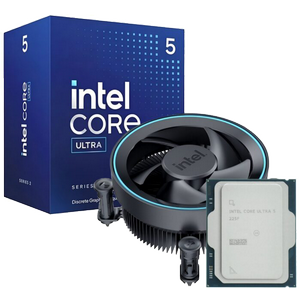
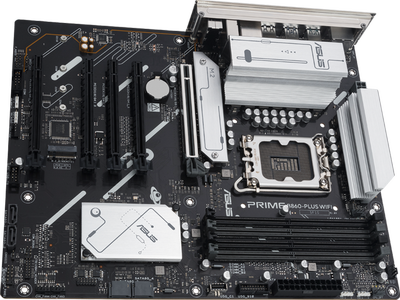
Chosen processor and motherboard.
Been there, done this numerous times. This time the choices were:
- Socket: LGA 1851. I usually choose Intel CPUs as they are the industry standard and are not overly expensive. I have had satisfaction from AMD chips in the past and would not hesitate to use them again but I guess I just follow the pattern. I chose the latest socket at the time because it was best supported by motherboards and had the latest and fastest technology.
- CPU: Intel Core Ultra 5 225. I had a choice of options here from the Arrow Lake-S range. I didn't need a high performance processor and didn't want to spend more than necessary so that narrowed my choices down to the Core 5. The Core 3 was too weak to consider. I wanted on chip graphics, so that narrowed my choices down to the 225, the 235 or the 245. My supplier did not offer the 235 and the only 245 they offered was the 245K. The 245K was a high performance, 125W unit that required a 3rd party cooler. The 225 was a 65W unit that came with its own cooler. There wasn't a huge price difference between the 2 but I was put off by the higher power consumption and the problem of heat dissipation. I reasoned that I didn't need the extra performance so I went for the simpler and cheaper option.
- Motherboard: ASUS Prime B860-Plus Wifi-CSM an implementation of Intel's B860 chipset. I wanted a full ATX form factor as I had a full ATX case and I wanted as many USB ports as I could get. I also needed onboard graphics. This ticked all the boxes and the price was reasonable so I bought it.
- RAM: Lexar THOR RGB 2nd Gen 32GB (2x16GB) DDR5 6000MT/s CL36. Modern computer software is a disgraceful bloated mess so more RAM is definitely better. The typical standard at the time was 32GB of DDR5 so I went with that. It seems absurd that a desktop computer could require such an ENORMOUS amount of RAM but that's the fucked up mess of modern software. I remember when PCs had less than 1 MB of RAM and they ran perfectly! What a joke! Some large organisation needs to take the computer industry by the scruff of the neck and DEBLOAT AND SIMPLIFY THE LIVING FUCK OUT OF IT! It's an absolute disgrace and NO! computers are certainly NOT better than they were 20 years ago! BTW, thanks to a shortage of certain types of memory chips the cost of RAM for my new machine was more than a third of the total. This is ridiculous! Also ridiculous is the rotating RGB lightshow that these memory modules put on 24/7. Why?

- SSD: Kingston SNV3S NV3 500GB PCIe Gen4 NVMe M.2. I only use the SSD for installed programs and Windows itself. All my data I keep on a large HDD so I did not need the 1TB that was the typical option. 500GB was the budget option so I went with that. I chose M2 because it is simpler than SATA.
- HDD: I had a perfectly functional WD 4TB SATA drive from my previous machine so I just kept that. I have a LOT of photos and videos and I need at least 4TB. Soon I will need more but I will cross that bridge when I come it.
Total cost was $1500 delivered, from Centre Com, which was very competitive, accurate and fast. I have been using Centre Com for decades and have nothing bad to say about them. It was a bit more than I wanted to pay, considering that I already had the case, power supply and HDD but prices have gone up, especially for RAM, so I had no choice. It's still $2K cheaper than a Mac Studio and without all the controlling, limiting bullshit that Apple bring to all their products.
Assembly
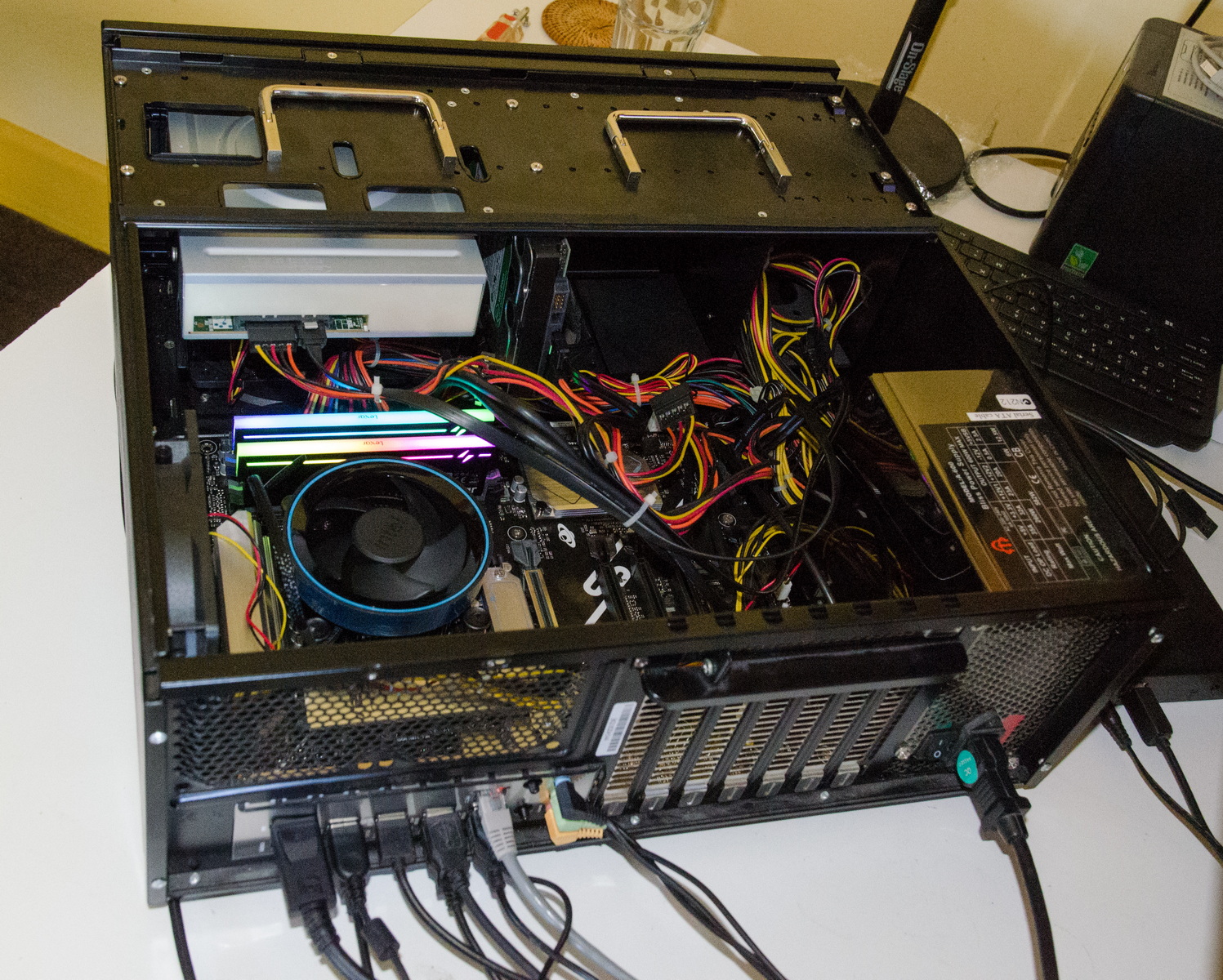
The fully assembled new PC in its case with all the peripherals connected (click to enlarge).
Assembly is a bit more complicated when you have to prep a new case and power supply but my old machine had a good case, power supply and HDD and I intended to keep them, so my first step was to remove everything I didn't need. I disconnected ALL the cables, removed the old SATA SSD, removed the old graphics card, unscrewed the MB retaining screws and removed the MB complete with RAM and CPU.
Then I went in with my vacuum cleaner and sucked away all the dust that I could find, especially from the dust filters on all the fans.
The next step was to install the CPU. This is always a little stressful as you don't want to mess that up! I set up a silicon mat and placed the MB on it. Then I carefully removed the CPU from the box, lifted the clamp lever and opened the socket. It was straightforward to drop the chip in as there was only one way it could go. You do want to be careful doing this though as if you bend a pin you'll be in trouble. Zero insertion force is a great idea and once the CPU is in place you only need to close the lid and the clamp lever to hold it all in place. Nice!
The next step was to install the MB into the case and screw it down. This was easy as I already had the ATX standoffs in place from the previous MB and this one matched exactly. No problem there.
The biggest problem was the CPU cooler which uses some strange rotating, resettable scrivets. I HATE scrivets and these were a pain. YES, if you know how they work it's fine but Intel do NOT provide a proper explanation of how to set them up. Their installation guide just says push them in. Well you can only push them in if they have been preset correctly and Intel do NOT tell you that. I tried to just push them in but that didn't work and I had to remove the cooler and try again. Trying again is bad as it disturbs the heatsink goo between the CPU and the cooler. Not ideal! I rotated the scrivets and got it right eventually but I was NOT happy. If you disturb the heatsink goo too much the CPU may overheat and possibly even melt and THEN you'll be annoyed!
This was the start of what became a theme in this install: BAD INSTRUCTIONS which is indicative of a major problem in the world today: INCOMPETENCE and a LACK OF CARE about the end user. I guess the manufacturers will say: "This kind of thing is meant to be done by trained experts who already know how to do it so we don't need to provide proper instructions." Well I call BULLSHIT! I bought the unit and it is not difficult to install. You just need to provide a little more information. If the morons who compiled the excuse for an instruction manual had actually tested their drivel on ordinary people they would have discovered the holes in their explanation and could have fixed them. It's not hard people, you just need to care about your work!
The next job was installing the M2 SSD. This seems like a doddle BUT it isn't as simple as you think. I had to add a little rubber spacer as the unit was only single sided, then I had to remove the plastic covering the heatsink goo. Yes folks, SSDs now need heatsinks. The SSD slid neatly into place but it sits up a little at the far end, (as intended), so you need to hold it down precisely to match the cutaway on the unit with the screw hole using one hand, then you need to fit the heatsink on top of it using the other hand and then, using your 3rd hand you can screw it into place. Easy if you have 3 hands. Thanks pests. Man! What a pain! The slightest pressure from the heatsink on the SSD will knock it out of alignment unless you keep pressure on it. It's hard to align the screw holes on the heatsink with the motherboard as you can't see once it's in position. The process was easy before they put heatsinks on them. Pffft!
The RAM was pretty straightforward to install, just gently push the little levers out and insert the modules until they click back into place. Simple IFF you can figure out which 2 of the 4 slots they go into and IFF you get them THE RIGHT WAY AROUND. The motherboard quick installation guide sort of gives you the info you need about the slots and if you look closely at the MB you can figure it out but would it really kill them to give you slightly better instructions? Similarly the question of which way around the memory modules go. Yes, they only go in one way BUT the slot in the DDR5 module is only very SLIGHTLY off centre so just looking at it doesn't exactly shout at you as to which way to put them in. Why people? What was wrong with an obviously off centre notch? Why do you need to have it almost in the middle? It's dumb people! Dumb!
Next step was to reconnect all the cables. The power supply cables, the fan power cables, the SATA cables to the old HDD and BluRay unit, the front of case controls and USB connectors. No real problem with any of that.
Then place the box back on my desk and reconnect all the peripherals. I have so many USB devices. Which should go into which ports? I need 4 audio ports but there are only 3 on the back. Are they in the right holes? HDMI or DisplayPort? Ah well, we'll sort it out later if they don't work.
Then the moment of truth: Plug it in and turn it on...
Windows 11 Install
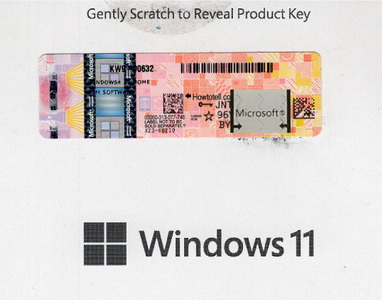
A recreation of my Windows 11 envelope but exactly where to scratch? (The original was more obscure.)
It booted up to the BIOS screen which reported everything functioning correctly so no worries. Time to install Windows 11.
You can buy Windows 11 in various forms including a downloadable form but the CHEAPEST was a DVD. Why? Ah well! If it's cheapest then that's what I'm buying. I looked at the cardboard envelope. It said "Gently Scratch To Reveal Product Key". Fine but where to scratch? There is an awful lot of detail on that fancy holographic label and call me an idiot if you like but it was NOT clear to me. Sure it looks obvious now! At the time however I was a little stressed from the assembly and the impending installs and I didn't know what to do. First of all: Why bother with a scratchy anyway? The envelope comes sealed in another envelope. There's no need for a scratchy. There never used to be but now there is. Yet another pain dreamed up by some fuckwit trying justify his position to another fuckwit who is his boss. The world is in a huge mess due to such fuckwits who are EVERYWHERE! Second, if you do have to have a scratch, put an arrow from the instruction directly to the area to be scratched. You'd think that would be easy enough to do but NO! Fuckwits don't think of such things and they do NOT test their idea on ordinary people.
Eventually I figured it out and typed in the key but it failed! Why? Because there was a tiny patch of scratch coating covering a tiny piece of one letter and I read an F as an R. Fuck off Microsoft! This is exactly why you don't put scratchies over a key! I tell you: I'm over the fools of this world making EVERYTHING complicated and dysfunctional. FUCKWITS!
Anyway, once I figured that out the installation was straightforward and I was into the real pain: Application software.
Application Software Install



Just a small fraction of the many applications I had to reinstall...
I use my computer for half my waking day, EVERYDAY! I use it for many different purposes and I use a LOT of different applications to achieve that. Word processing, spreadsheets, web browsing, text file creation, desktop publishing, graphics creation, multi-channel audio recording, processing and mixing, music notation generation, video file editing, video streaming, music file playing, video file playing, web page creation, video conferencing, photo processing, photo viewing, various games both online and offline, programming environments, utilities etc. There's a lot!
Yes! A lot! It takes days to install everything and get it all properly configured to suit my style. Days! That is why I dread having to reinstall Windows, as it means reinstalling EVERYTHING! Microsoft can bullshit on all they like about the latest Windows automatically reinstalling all your apps. It's bullshit. If they reinstall some of them they will not work. The rest will not even be attempted. It's just bullshit. What else would expect from the people who brought you Clippy!
Anyway I got on with it, eschewing all the online apps from Microsoft and Adobe and instead reinstalling from my OLD DVDs dating back to the days before subscription software. They still work and I paid for them so "fuck 'em"! I don't care if the stuff is a decade out of date, in fact, I prefer it that way! The new stuff sucks. I went ahead and blocked the ability of Adobe to communicate through the firewall. I don't want those arseholes forcibly updating my software to some insanely expensive subscription disaster...
It's a slow and tedious process. Everyday I find some forgotten piece of software that I need to reinstall. In some cases it has a complex configuration file that I need to generate from scratch. Ah well! A bit at a time. I'm still not finished but I guess it's mostly done.
Conclusion
I was forced into upgrading my main PC and thereby forced into migrating to Windows 11. I preferred Windows 7. I liked Windows 7. I didn't want to move! Fuck Microsoft and their forced auto-update bullshit and their never-ending roundabout of pointless change. Fornicate them between the eyes! Anyway I had no choice so I got on and did it.
I've been using Windows 11 for a couple of years now in my caravan PC so I knew what I was in for and hence I felt no shock after the migration. It's ok I guess. I gripe about certain things but in reality I can still get my work and recreation done much as before. That would NOT be the case had I attempted to migrate to Apple!
The process took 2 days and $1500. It was unnecessarily irritating at times due to the short-sightedness and lack of care from industry pests but it wasn't too bad. Assembling a new PC from components is generally fun and mostly straight forward. Just make sure you do your research and make sure all your bits are compatible.
Hopefully this PC will be my workhorse for the next 10 years and who knows? It might even see me out.
Now excuse me, I believe it's time to play some Hearthstone.
Currently reading:
The Villain Wants to Live by Jee Gab Song & Daon Creative